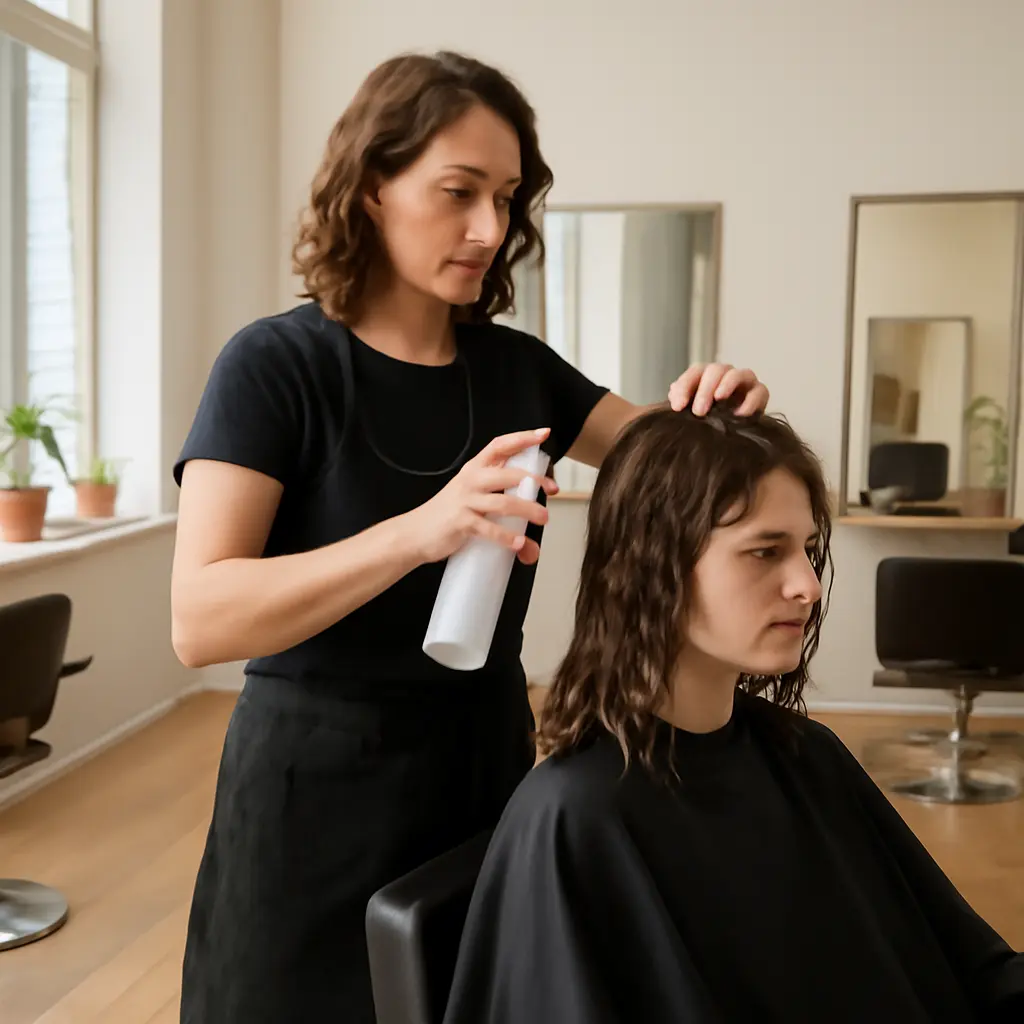

Wavy hair can lose definition or fall flat when products are too heavy, applied in the wrong order, or disturbed before they dry. Hairstylists’ practical answer is to layer a light leave-in or curl cream under a hold product—usually gel or mousse—on evenly damp hair, then let the waves dry with minimal handling. The right combination depends on strand thickness, density, porosity, and desired finish; there is no universal formula or scientifically established “all-day hold” guarantee. Below, we explain the product order, compare common layering combinations, and outline techniques for drying, refreshing, and adjusting a routine.
Product layering defines wavy-hair hold
Product layering is the deliberate application of styling products in sequence so each serves a distinct purpose: a conditioning product supports softness and manageability, while a styler helps shape and maintain the wave pattern. The American Academy of Dermatology advises applying conditioner mainly to the lengths for people with fine or straight hair and throughout the hair for people with dry or curly hair, reflecting how hair characteristics affect product placement. For waves, the useful principle is to add only as much conditioning weight as the hair can tolerate, then use a styling product that supplies enough hold.
“Wavy hair” commonly describes patterns between straight and curly hair, often grouped as type 2A, 2B, and 2C in popular hair-typing systems. These labels are descriptive rather than a clinical diagnosis, and a single head can have more than one pattern. Fine, loose waves may be weighed down by rich creams, while thicker or coarser waves may need more conditioning and stronger hold. Product layering works best as a method to test and tailor—not as a fixed number of products.
The base layer: leave-in conditioner or curl cream
A base layer is a lightweight conditioning product applied before the main styler. A leave-in conditioner is designed to stay in the hair after washing; a curl cream typically adds more smoothing and conditioning, and may offer some shape support. Start with a small amount distributed through the mid-lengths and ends. If waves become limp, greasy, or slow to dry, reduce the dose, switch to a lighter formula, or skip the base layer.
The American Academy of Dermatology notes that conditioner helps reduce friction and improve manageability, but a styling routine should reflect hair texture and condition. That makes a leave-in most useful when the hair feels dry, tangled, or rough—not automatically necessary for every wash. For fine or low-density waves, a small amount of leave-in may be enough; for dry, dense, or coarse hair, a cream can provide a more substantial base.
The hold layer: gel or mousse
The hold layer is the product that helps waves keep their shape as they dry. Gel generally creates more structure and can form a temporary cast around the hair; once fully dry, gently scrunching can soften that cast. Mousse is often lighter and can add body, making it a practical option for waves that collapse under richer products. Formulas differ, so labels alone cannot predict the exact result.
For a simple starting routine, apply a light leave-in only if needed, followed by gel or mousse while hair is still damp. Use a little more hold product if the waves separate or lose shape quickly; use less cream or leave-in if the roots go flat. Product performance depends on hair condition, application, weather, and drying technique, so “all-day hold” is best treated as a goal to test rather than a guaranteed outcome.
Layering technique preserves wave definition
Application technique determines whether products coat the hair evenly without disrupting the wave pattern. A useful sequence is to begin with clean, conditioned hair, remove excess water gently, apply a modest amount of any conditioning base, and distribute the hold product from mid-lengths to ends. Scrunching encourages the natural pattern; combing or brushing after styling can separate clumps and make the finished texture look less defined.
Apply to damp hair and distribute evenly
Damp hair gives styling products water to spread through, while hair that is dripping wet can dilute a product or make application difficult. After washing, gently squeeze out excess water with a microfiber towel or a soft cotton T-shirt rather than rubbing vigorously. Work in sections if the hair is dense, and smooth or rake the product through before scrunching upward to encourage wave clumps.
Use the smallest workable amount first. Add more only if some sections feel uncoated or fail to hold their shape. This approach limits buildup and avoids the common mistake of applying a large quantity of cream and then trying to compensate with more gel. If products pill, feel tacky, or leave residue, test them separately or adjust the amount and order.
Dry with minimal disturbance
Once styling products are in, touching the hair repeatedly can disrupt forming wave clumps and contribute to frizz. Air-dry when time allows, or diffuse with low airflow and a low or moderate heat setting. A diffuser can support volume and reduce direct airflow on the waves, but drying methods should be comfortable and should not expose hair to unnecessarily high heat. Avoid scrunching or separating the hair until it is fully dry.
When a gel cast forms, gently scrunch the dry hair to soften it while retaining definition. If the hair still feels wet or cool, wait before scrunching; breaking the cast too early can leave waves less defined. For extra root lift, diffuse with the head tilted or use clips at the roots while drying, taking care not to disturb the lengths.
Wavy-hair routines vary by texture and hold needs
A good layering routine is adjustable. Fine, loose waves usually benefit from fewer and lighter products, while thick or coarse waves may need more conditioning and a stronger styler. Humidity, activity, and the length of time between washes also affect results. The following combinations are starting points rather than prescriptions.
Fine or loose waves: prioritize lightweight hold
For fine or loose waves, try a lightweight leave-in—or no base layer—followed by mousse or a light gel. Apply sparingly, especially near the roots, where excess product can reduce lift. If the waves look stringy or feel coated, clarify according to the product instructions and simplify the next routine.
Thicker or drier waves: add conditioning selectively
Thicker, coarse, or dry waves may respond better to a modest amount of leave-in or curl cream under a medium- or strong-hold gel. Focus conditioning product on the lengths and ends, then apply enough styler to encourage the waves to stay grouped. If the hair feels stiff, reduce the gel or soften the dry cast; if it loses definition rapidly, try a stronger-hold formula or improve drying time before changing several products at once.
Refresh between wash days
A refresh is a small adjustment to revive flattened or frizzy waves without repeating the full wash routine. Lightly mist the hair with water, reshape sections with the hands, and use a small amount of mousse or diluted leave-in only where needed. Too much added product can accumulate and make subsequent styling harder. If the scalp feels oily or the hair has substantial residue, a wash may work better than repeated layering.
A simple test helps refine all-day hold
To identify what works, change one variable at a time: the base product, the amount of styler, or the drying method. Note whether the waves keep their shape, feel touchable, and retain volume through the day. A basic comparison chart can track product combination, drying method, definition after drying, and how the hair looks several hours later. This practical test is more useful than assuming a product will perform the same way on every wave pattern.
- Wash and condition as usual, then gently remove excess water.
- Apply a small amount of leave-in or curl cream only if the hair needs conditioning.
- Apply mousse or gel evenly, scrunching to encourage the wave pattern.
- Air-dry or diffuse with gentle airflow, and avoid handling until fully dry.
- Assess the result and adjust one part of the routine at the next wash.
For example, if fine 2A waves look flat by midday, the first adjustment could be skipping cream and using a light mousse. If dense 2C waves feel dry and expand in humidity, a small amount of cream beneath a stronger-hold gel may be worth testing. These examples illustrate routine choices, not guaranteed outcomes: individual hair, climate, and product formulas all matter.
Conclusion: balance conditioning, hold, and drying
Effective wavy-hair layering pairs only as much conditioning as the hair needs with a hold product suited to its texture and desired finish. Apply products on damp hair, distribute them evenly, scrunch to encourage definition, and allow the waves to dry with minimal disturbance. Fine waves may do best with a lightweight routine; thicker or drier waves may benefit from a conditioning base and stronger hold. Start with a simple combination, record how it performs, and adjust one step at a time rather than adding products indiscriminately.
Sources: American Academy of Dermatology Association, “Tips for Healthy Hair,” https://www.aad.org/public/everyday-care/hair-scalp-care/hair/healthy-hair-tips; American Academy of Dermatology Association, “How to stop damaging your hair,” https://www.aad.org/public/diseases/hair-loss/insider/stop-damage; Cleveland Clinic, “Is It Bad to Brush Your Hair When It’s Wet?,” https://health.clevelandclinic.org/is-it-bad-to-brush-your-hair-when-its-wet