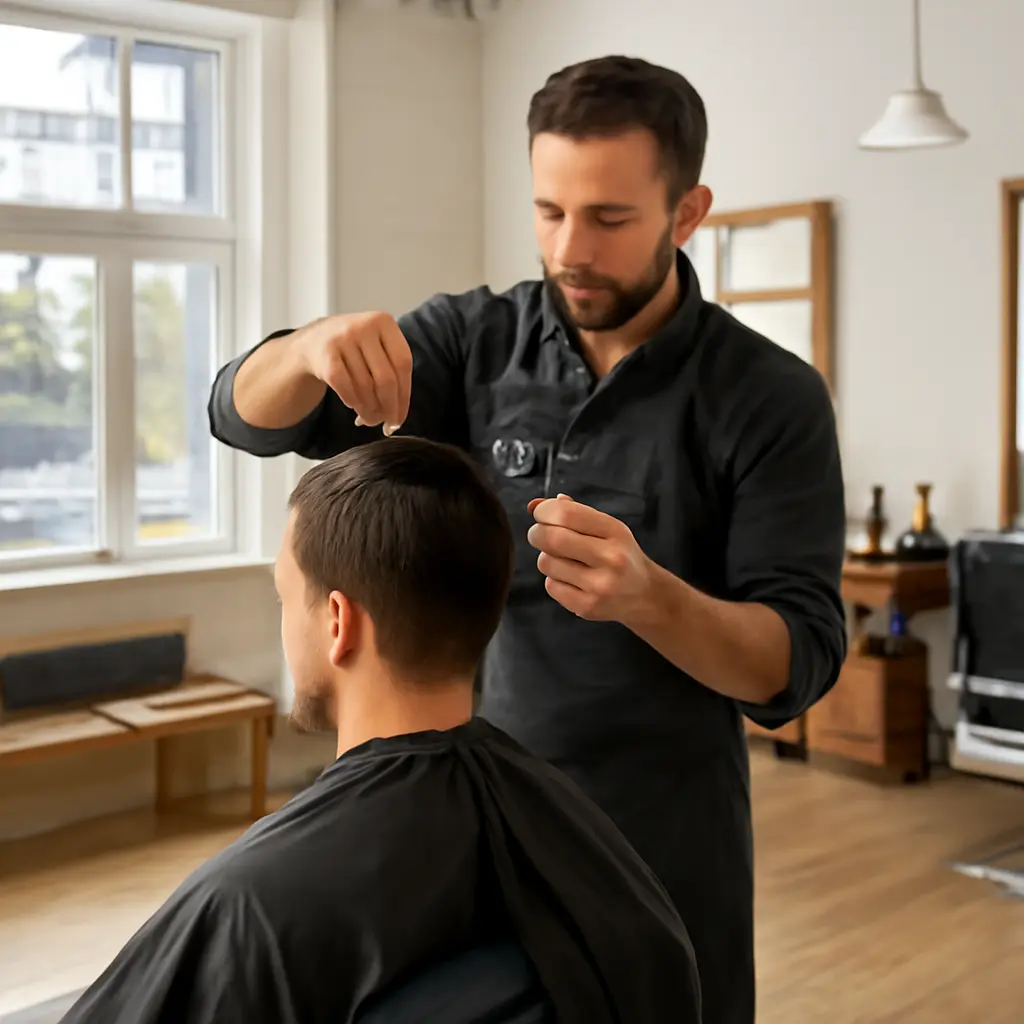

A barber’s hair division is the way the hair is separated into workable sections before styling product is applied. For gel styling, barbers typically part damp or dry hair according to the intended finish, create clean sections with a comb or fingers, and apply gel in controlled amounts—often working from the back or lower layers toward the front. The exact pattern depends on hair length, density, curl, and the style; there is no single standard number of sections. Understanding the parting tools, sectioning patterns, product timing, and hair-specific adjustments helps explain why professional styling looks more even and stays in place without unnecessarily weighing hair down.
How barbers divide hair before gel application
Sectioning means separating hair into manageable panels so a barber can direct, coat, and shape it with control. The National Association of Barber Boards of America describes barbering as including hair cutting and styling, but its model regulations do not prescribe one universal gel-sectioning method. In practice, barbers adapt basic sectioning principles to the client’s head shape, hair growth pattern, desired part, and product instructions.
A useful distinction is between a haircut section and a styling section. A haircut section supports cutting and measurement; a styling section is a temporary panel used to distribute product and set direction. For a short, uniform style, the barber may need only a few broad passes. For longer hair, a side part, waves, or curls, narrower panels can help keep product distribution and direction consistent.
The starting condition: damp, towel-dried, or dry hair
Hair condition determines how the barber sections and applies gel. Many water-based styling gels are intended for damp or towel-dried hair, while some styles are refined on dry hair for stronger texture or more precise placement. The American Academy of Dermatology advises applying styling products according to their directions and avoiding excessive heat or rough handling, since wet hair can be more vulnerable to breakage.
Before applying product, a barber generally removes excess water, detangles where needed, and identifies the natural fall of the hair. Very wet hair can dilute gel and make the result less predictable; nearly dry hair may set quickly and be harder to redistribute. The product label is the best guide because gel formulas differ in hold, finish, and recommended application.
The part and growth pattern guide the division
A barber usually establishes the intended direction before making styling sections. The natural part, cowlicks, crown whorl, and hairline affect how hair lies. A comb’s tail can trace a clean side part or separate a panel, while the barber’s fingers may be preferable when a softer, less defined finish is wanted.
For a comb-over, for example, the barber may separate the top from the sides and direct the top across the head. For a slick-back, the hair is generally directed from the front toward the crown, with attention to the crown’s growth pattern. Following the natural direction can reduce resistance and help the finished style look more controlled.
Common sectioning patterns for gel styling
The section pattern is a practical choice, not a fixed formula. Barbers commonly use broad top-and-side divisions, horizontal or diagonal panels, or finger-separated subsections. These approaches overlap: a barber may first divide the top from the sides, then create smaller panels within the top to distribute gel and establish the final shape.
Top, sides, and back: the basic division
For many short and medium styles, the barber treats the top, sides, and back as separate working zones. The top often needs the most direction and shaping, while the sides and back may require less product or a different finish. The barber can keep each zone distinct with clips, a comb, or hand placement, then blend the styling direction around the head.
This division is useful for styles such as a side part, quiff, or slick-back. It also helps prevent a common styling problem: applying the same quantity of gel everywhere even though hair length and density vary across the head.
Panel-by-panel application for longer or denser hair
When hair is longer or dense, the barber may separate it into smaller panels so product reaches more than the surface layer. A tail comb can create precise partings; clips hold completed sections out of the way. Gel is spread between the hands and worked through each panel, usually from the roots or mid-lengths toward the ends depending on the style and product guidance.
Smaller panels are especially helpful when the goal is a uniform slick finish or defined waves. They can also make it easier to notice uneven coverage before the gel begins to set. However, narrow sections are not automatically better: for a loose, natural style, too much precision can create unwanted lines or stiffness.
Finger sectioning for texture and curls
Finger sectioning means separating and directing hair by hand rather than making sharply defined comb partings. Barbers may use it for textured, curly, or deliberately tousled styles, where preserving the hair’s natural grouping matters more than creating a flat, uniform surface. The barber can rake, smooth, scrunch, or shape each area according to the curl pattern and desired finish.
Curly hair does not always benefit from repeated combing after product application. The American Academy of Dermatology recommends gentle handling of textured hair and notes that styling practices can contribute to damage when they create excessive tension. A barber can therefore use wider finger-separated sections and avoid pulling curls straight when the aim is to retain definition.
How barbers apply gel across the sections
Once the hair is divided, the barber controls gel quantity and order of application. Gel is typically emulsified between the palms before it touches the hair, which helps reduce concentrated clumps. The barber then works through the chosen sections and combs or shapes the hair while the product remains workable.
Start with a small amount and build gradually
The amount needed depends on the formula, hair length, density, and desired hold. Starting modestly and adding more is generally easier than trying to correct an overloaded section. Excess product can leave hair stiff, flaky, or visibly coated; the American Academy of Dermatology also advises using styling products in ways that suit the hair and scalp rather than relying on heavy application.
A barber may apply product first to the area requiring the most control, then spread a smaller remainder through adjacent sections. For a high-volume style, product may be concentrated away from the roots; for a sleek style, the barber may work closer to the roots to keep flyaways in place. The gel manufacturer’s directions should take precedence over a general technique.
Work with the style’s direction and finish
After distributing gel, the barber uses a comb, brush, or fingers to establish the finished direction. A fine-tooth comb can create a smoother, more defined part, while a wider comb or fingers leave more texture. The barber may refine the hairline and crown last, since these areas often reveal whether the product has been distributed evenly.
For a side-parted style, the part is usually set before the rest of the top is combed into place. For a slick-back, the barber directs the hair rearward in controlled passes. For textured curls, minimal reworking after shaping can help preserve the intended pattern as the gel dries.
Set, dry, and check the result
The final stage is allowing the style to set, either by air-drying or with a dryer when appropriate. A barber checks the outline, part, crown, and balance between sections, then makes small adjustments before the gel becomes fully set. Heat use depends on the desired finish and product instructions; excessive heat can damage hair, so controlled temperature and distance matter.
A practical example is a short side part: the barber identifies the natural part, divides the top from the sides, applies a small amount of gel through the top, combs it across, and smooths the sides. A longer slick-back may require several top panels so the product reaches the inner layers and the hair is directed evenly toward the crown.
What changes the sectioning method
Hair division is adjusted to the person and the target style rather than copied mechanically. Length, density, curl pattern, scalp sensitivity, and the gel’s hold all influence the choice. The U.S. Bureau of Labor Statistics describes barbers’ work as including shampooing, cutting, trimming, and styling hair; the practical sectioning decisions are part of adapting those services to individual clients.
Hair length and density
Short hair may be styled in broad zones because the product can reach most strands quickly. Longer or denser hair often benefits from smaller panels, since the outer layer can otherwise receive more product than the hair beneath it. The barber may also use different quantities in different zones to avoid flattening areas that need lift.
Curl pattern and desired definition
Straight hair can often be combed into a continuous shape, while curls may need to be separated and shaped without disrupting their natural groupings. For defined curls, the barber may work in sections and use fingers to distribute product. For a smoother finish, the barber may use a comb and more deliberate directional passes.
Scalp comfort and product suitability
A barber should consider scalp comfort and any known sensitivity when selecting a styling product. The U.S. Food and Drug Administration advises consumers to follow cosmetic product labeling and stop using a product if an adverse reaction occurs. If a client reports irritation or a history of reactions, discussing the product before application is sensible; gel should not be applied to irritated or broken skin without appropriate professional advice.
Conclusion: precise sections make gel styling more controlled
Barbers divide hair before gel application to manage direction, coverage, and shape. The basic top-sides-back division suits many short styles, while panel-by-panel or finger sectioning can help with longer, denser, or curlier hair. A barber also accounts for dampness, natural growth patterns, product instructions, and the finish the client wants. If you want to recreate a barber’s result at home, ask which sections they used, how damp the hair should be, and how much gel to apply; then follow the product label and adjust the technique to your own hair.
Sources: National Association of Barber Boards of America, Model Barbering Act and Regulations, https://www.nabab.org/; American Academy of Dermatology Association, Hair styling without damage, https://www.aad.org/public/everyday-care/hair-scalp-care/hair/hair-styling-without-damage; American Academy of Dermatology Association, Black hair: Tips for everyday care, https://www.aad.org/public/everyday-care/hair-scalp-care/hair/care-afro-textured-hair; U.S. Bureau of Labor Statistics, Barbers, https://www.bls.gov/ooh/personal-care-and-service/barbers-hairstylists-and-cosmetologists.htm; U.S. Food and Drug Administration, Cosmetics: Safety Information, https://www.fda.gov/cosmetics/cosmetics-science-research/cosmetics-safety-information.