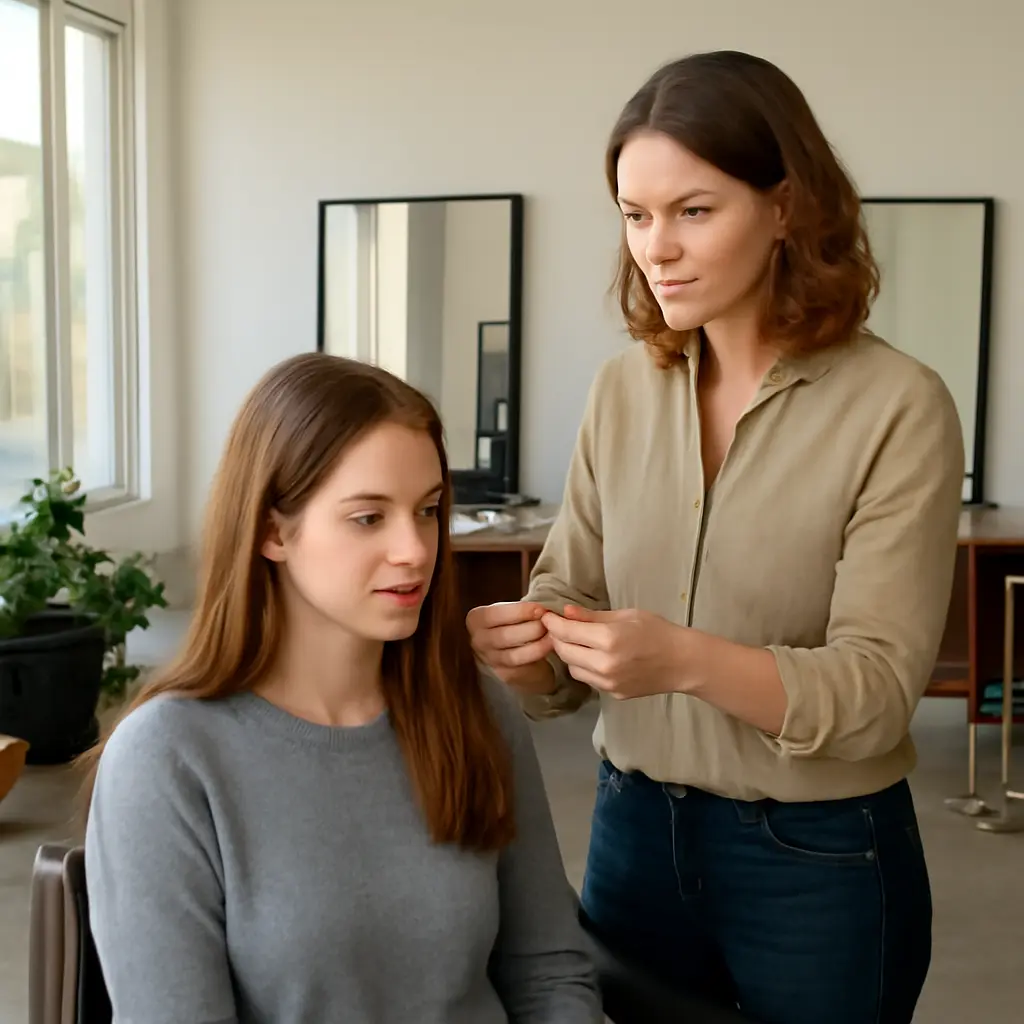

Hair thickness is not one simple trait: it can mean the width of an individual hair fiber, the number of hairs on the scalp, or the overall fullness created by both. Thick strands are generally wider than fine strands, but they do not automatically mean denser hair, greater strength, or easier styling. Understanding the difference helps explain why coarse hair may feel heavy yet still break, why strand diameter affects drying and product choice, and why genetics, curl pattern, damage, and scalp health all matter. Dermatology references describe hair fiber diameter as variable, while a commonly cited clinical range for scalp hair density is roughly 80,000–120,000 hairs; these measures describe different things, not a universal standard for “thick hair.”
Hair Strand Thickness: What the Attribute Actually Measures
Hair strand thickness usually refers to the diameter of a single fiber, measured across the shaft. The American Academy of Dermatology distinguishes hair thickness from hair density: diameter concerns each strand, whereas density concerns how many follicles produce hair in a given area. “Coarse” is commonly used for a larger-diameter fiber, “medium” for an intermediate fiber, and “fine” for a smaller-diameter fiber. These are practical descriptions rather than universally standardized clinical categories, and a person can have fine strands in a dense head of hair or coarse strands with comparatively low density.
Hair fibers are made primarily of keratin and have a layered structure: the cuticle on the outside, the cortex beneath it, and, in some fibers, a central medulla. Diameter and internal structure influence how a strand bends, reflects light, and responds to heat or chemicals. They do not alone determine the health of the follicle or the number of hairs growing on the scalp.
Fine, Medium, and Coarse Strands
Fine, medium, and coarse describe relative fiber diameter. Fine strands may feel soft and look less substantial individually; coarse strands often feel more substantial and may resist bending. Medium is a useful middle category, but there is no single measurement threshold that applies across every population, body site, or testing method. A simple at-home comparison against sewing thread can offer a rough impression, but it is not a precise measurement because thread type and lighting vary.
Researchers can measure fiber dimensions using microscopy or specialized instruments. In practice, a stylist’s touch-based assessment is approximate. The useful takeaway is to treat these labels as a description of strand behavior, not a diagnosis or a ranking of hair quality.
Strand Thickness Is Not Hair Density or Fullness
Density refers to the number of hairs in a scalp area, while fullness is the visual impression created by density, strand diameter, color contrast, length, curl, and styling. A head with many fine hairs can appear full; fewer coarse hairs may also create substantial coverage. The often-quoted estimate of about 80,000–120,000 scalp hairs is a broad clinical approximation, not a personal target or a test of strand thickness. Hair counts also vary naturally and change with age and individual biology.
Hair Strand Thickness Influences Feel, Movement, and Styling
A strand’s diameter affects its mechanical behavior, but the final result depends on more than diameter. Fiber curvature, moisture, cuticle condition, chemical processing, and the length of the hair all contribute. This is why two people with similarly coarse strands can have very different experiences, and why “thick hair” does not guarantee a particular styling result.
Bending, Volume, and Movement
Coarser fibers generally require more force to bend than finer fibers of otherwise similar structure. This can make some styles hold their shape, but it can also make hair feel stiff or resistant to smoothing. Fine strands may lie flatter and respond quickly to styling, yet lose shape or volume more readily. Curl pattern changes the picture: curly and coily fibers have bends that affect how strands spring, tangle, and distribute volume, so diameter alone cannot predict movement.
A useful real-world distinction is between strand-level volume and overall hair mass. Fine strands in high density can create a large, voluminous style, while coarse strands in low density may not. Haircut shape, layering, and length can alter the visible result without changing the diameter of the fibers.
Water, Drying, and Product Feel
Drying time is often blamed on strand thickness, but it is also strongly affected by hair length, density, curl pattern, porosity, airflow, and how much water remains after washing. More hair or tightly packed curls can take longer to dry even when individual strands are fine. Products can likewise feel different depending on strand diameter and density: heavy oils or rich conditioners may weigh down some fine, low-density hair, while coarse or highly textured hair may benefit from richer conditioning. These are starting points, not rules; product response is individual.
Hair Strand Thickness Does Not Guarantee Strength
Strength is the ability of a fiber to withstand force before stretching, deforming, or breaking. A larger diameter can contribute to a greater load-bearing capacity, but it does not make a strand indestructible. The condition of the cuticle and cortex, repeated heat, bleaching, chemical treatments, friction, and wet handling can all change breakage risk. The International Journal of Trichology and hair-science research describe hair fibers as materials whose mechanical properties vary with structure and treatment history.
Breakage, Damage, and the “Coarse Hair Is Stronger” Myth
Coarse hair may tolerate some styling forces better than a finer fiber, all else being equal, but “coarse” does not mean damage-proof. Chemical bleaching and repeated high heat can weaken the fiber, while rough towel drying, tight hairstyles, and aggressive detangling can create mechanical stress. The American Academy of Dermatology advises minimizing damaging practices and using gentle care; its guidance emphasizes that routine and treatment history matter alongside hair type.
Fine strands can be especially vulnerable to breakage because there is less material in each fiber, but coarse strands can also split, fray, and snap. If hair is breaking, look at recent chemical services, heat exposure, tension, and handling rather than assuming the cause is strand diameter alone.
Hair Fiber Versus Hair Follicle
The visible strand is a nonliving fiber produced by a living follicle beneath the skin. Its diameter is therefore distinct from follicle activity and scalp hair loss. A sudden change in shedding, widening part, patchy loss, or scalp symptoms should not be explained away as a change in “thickness”; the American Academy of Dermatology recommends consulting a dermatologist for concerning hair loss because causes and treatments differ.
Hair Strand Thickness and Practical Care Choices
Hair care works best when it accounts for several attributes together: strand diameter, density, curl pattern, scalp condition, and processing history. Thickness labels can guide experimentation, but they should not dictate a rigid routine. A simple chart could compare fine, medium, and coarse fibers across feel, likely styling response, and common product considerations; it should also note that density and damage can reverse the expected outcome.
Choosing Cleansing and Conditioning
Fine or low-density hair may feel weighed down by heavy leave-in products, so lighter formulas and modest application can be a practical trial. Coarse, curly, or chemically processed hair may feel better with more conditioning and careful detangling. Conditioner helps reduce friction during grooming, but the best amount depends on the hair’s response. Apply products to the lengths where dryness or tangling occurs, and adjust based on residue, softness, and manageability rather than a thickness label alone.
Heat, Chemical Services, and Handling
Regardless of diameter, repeated high-temperature styling and chemical processing can damage hair fibers. Use the lowest effective heat, avoid repeated passes, and handle wet hair gently because water changes fiber behavior and wet strands can stretch more readily. For detangling, begin at the ends and work upward with a suitable comb or brush. These measures reduce avoidable stress but cannot repair a fiber permanently once it is structurally damaged; trimming may be needed for split or frayed ends.
Conclusion: Read Hair Thickness as One Attribute, Not the Whole Story
Hair strand thickness describes the diameter of an individual fiber; it is different from scalp density, visible fullness, and fiber strength. Fine, medium, and coarse strands can each behave differently in bending, styling, drying, and product use, but curl pattern, damage, length, and grooming habits shape the outcome. Treat thickness as one useful clue rather than a promise that hair will be strong, dense, or easy to manage. For further guidance, compare your strand characteristics with density and curl pattern, adjust care one change at a time, and seek a dermatologist’s assessment for sudden shedding, breakage, or scalp changes.
Sources: American Academy of Dermatology, Hair loss: Tips for managing, https://www.aad.org/public/diseases/hair-loss/treatment/tips; American Academy of Dermatology, Hair loss: Who gets and causes, https://www.aad.org/public/diseases/hair-loss/causes/18-causes; Robbins, Clarence R., Chemical and Physical Behavior of Human Hair, Springer, https://link.springer.com/book/10.1007/978-3–xxxx (publication reference); Bhushan, Bharat, “Nanoscale Characterization of Human Hair and Hair Conditioners,” Progress in Materials Science, https://doi.org/10.1016/j.pmatsci.2007.04.001.